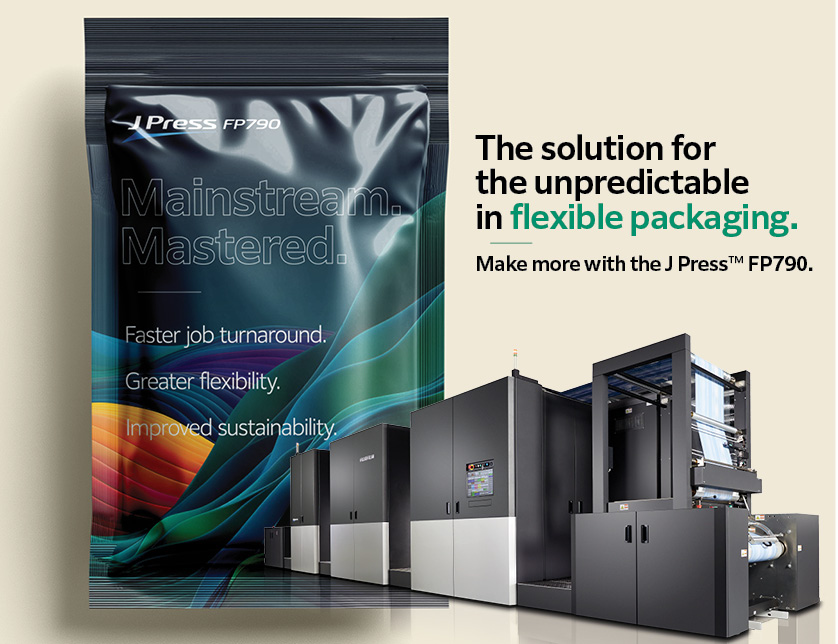
 If there was one message that came through during our “Mainstream Mastered” workshop on May 5 in Lohne, Germany, it was that digital flexible packaging has moved beyond proving what’s possible. Today, the conversation has shifted to production.
Hosted at delo: Dettmer Verpackungen GmbH, the event united converters, partners and industry experts to take an end-to-end look at how the J Press FP790 is helping manufacturers rethink mainstream flexible packaging. From printing and inspection to finishing and materials, the focus was on practical production and how converters can confidently make the flexo-to-digital shift.
The workshop highlighted real-world production workflows, market drivers and the growing commercial momentum behind the platform. The conversations weren’t about whether digital has a place in flexible packaging, but centered on identifying the right applications to transition first, integrating digital alongside existing flexo presses and improving efficiency without disrupting proven production workflows.
Those are the production challenges the J Press FP790 was designed to solve. Today, digital printing allows converters to move the right jobs from flexography and gravure into a more agile production environment. Faster changeovers, reduced waste, multiple SKUs, shorter run lengths and on-demand production all help improve efficiency while freeing conventional presses to do what they do best—run long.
The reason is simple. Today’s packaging market looks dramatically different than it did just a few years ago. Brands continue introducing new flavors, seasonal promotions, regional packaging, private label products and limited-time offerings. The result is more SKUs, smaller production quantities and tighter deadlines than conventional production was originally designed to handle.
That’s why more converters are evaluating which jobs make sense to shift from flexography and gravure to digital. Throughout the workshop, one message became clear. Many flexographic jobs below approximately 9,000 meters and selected gravure work up to roughly 22,000 meters are strong candidates for digital production.
The goal isn’t replacing conventional printing. It’s optimizing production by running the right job on the right technology.
Four Production Advantages. One Press.
One of the biggest misconceptions about digital flexible packaging is that it requires an entirely different production philosophy. The J Press FP790 was developed with the opposite approach.
The J Press FP790 brings together four production capabilities in a single platform:
The difference is that the J Press FP790 wasn’t developed to produce samples or niche applications. It was engineered to handle the everyday production work that keeps converters running while giving them the speed and flexibility to respond to changing customer demands.
The J Press FP790 wasn’t designed to replace flexography. It was designed to make flexography more productive. By shifting the right work to digital, converters can maximize existing equipment investments while creating more capacity for long-run production.
Why Water-Based Inks Matter
Water-based inks help converters meet growing food packaging, sustainability and regulatory expectations while reducing VOC emissions and hazardous chemistry. Combined with low setup waste and compatibility with solvent-free lamination, they support cleaner production, simplify compliance and help converters respond to evolving brand requirements.
Sustainability has become a production requirement. Brand owners are looking for packaging solutions that reduce environmental impact without sacrificing performance, while converters face increasing pressure to meet evolving regulations around recyclability, waste reduction and food safety.
Europe’s Packaging and Packaging Waste Regulation (PPWR), which takes effect in August 2026, is one example of how quickly those expectations are changing.
The J Press FP790 was designed to help converters stay ahead of that shift. Its water-based ink system supports food packaging applications while eliminating many of the challenges associated with solvent-based production. Operators are not exposed to hazardous cleaning chemicals, setup waste is significantly reduced and the press integrates seamlessly with solvent-free lamination and existing converting workflows.
The benefits extend beyond the pressroom. Converters gain a cleaner production environment, a more straightforward path to regulatory compliance and greater confidence when working with brand owners focused on sustainability, food safety and the future of flexible packaging.
Built for Today’s Materials; Tomorrow’s Opportunities
Flexible packaging isn’t standing still, and neither are the materials converters work with every day. As brands pursue more recyclable packaging and mono-material structures, converters need production platforms that can evolve alongside those changing requirements.
The J Press FP790 was engineered with that flexibility in mind, supporting a wide range of substrates including PET, OPP, BOPP and emerging materials such as MDO-PE. Just as important, it fits into existing converting environments. Rather than requiring new downstream equipment, the press integrates with existing laminating, slitting and pouch-making workflows, allowing converters to add digital capabilities while continuing to leverage their current investments.
That same philosophy shaped the development of the press itself.
From the beginning, the goal wasn’t to introduce another digital press. It was to create a production-ready platform capable of handling mainstream flexible packaging. The J Press FP790 combines 1200 x 1200 dpi image quality, water-based inks, exceptional color accuracy and seamless workflow integration to help converters confidently move everyday production work from flexography and gravure to digital.
Building that level of performance took time. Development began in May 2021 at Fujifilm’s Graphics Innovation Hub, where the platform underwent extensive validation across media, inks, Hybrid Software automation and ColorPath color management before making its public debut at drupa 2024.
Today, that investment is translating into commercial momentum. The J Press FP790 has four commercial installations across Europe with seven total orders, while installation times have been reduced from approximately 10 weeks to about four weeks for hardware installation and signoff before application training begins. North America is also preparing for its first customer installation at Quantum Flex Pack in Rockford, Illinois.
For us, that’s the real takeaway from Mainstream Mastered. The conversation is no longer about whether digital flexible packaging is ready. It’s about giving converters a practical way to integrate digital into existing operations, maximize their conventional equipment and position their businesses for the next generation of flexible packaging.
If you’re ready to see what that looks like in your operation, explore the J Press FP790, request a demo of the J Press FP790, talk to our team about flexible packaging or download the J Press FP790 brochure to start the conversation.